Commentary & Analysis
The Rise of the Organization of Turkic States
Introduction
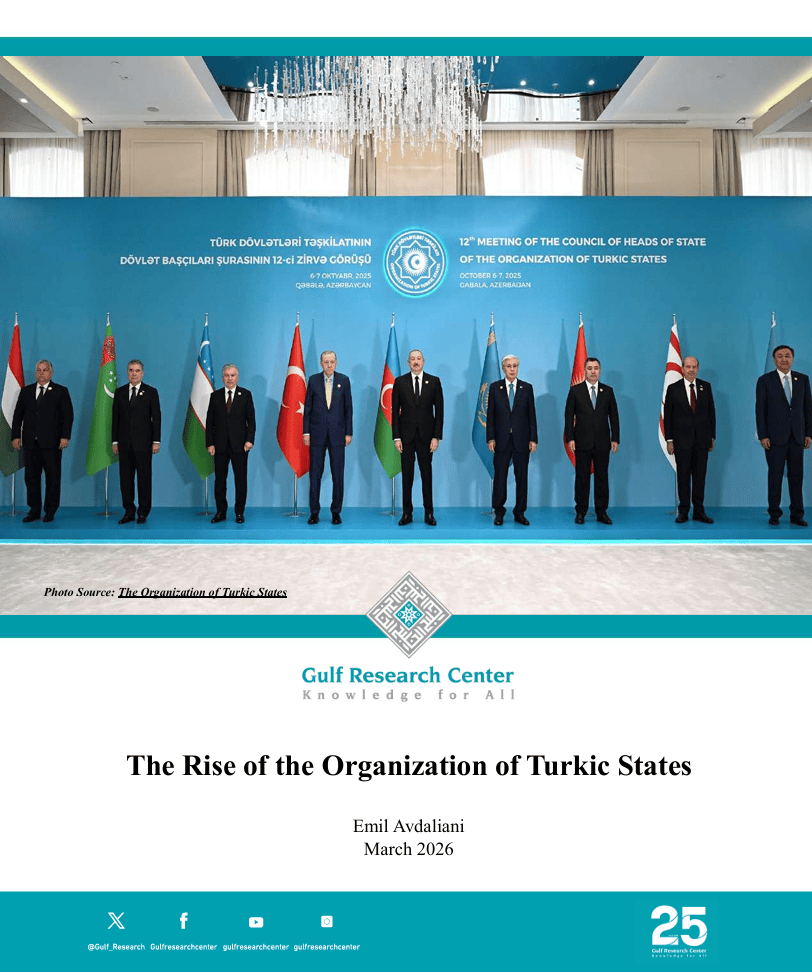
Over the past decade – and especially since its institutional rebranding in 2021 – the Organization of Turkic States (OTS) has evolved from a symbolic cultural forum into a geopolitical platform with expanding ambitions in security, defense coordination, and transregional connectivity. Conceived as the Turkic Council in 2009 by Turkey, Azerbaijan, Kazakhstan, and Kyrgyzstan, the body now includes Uzbekistan as a full member and Hungary, Turkmenistan, and Northern Cyprus as observers. The transformation reflects both domestic motivations among member states and external systemic pressures, including a shifting Eurasian power balance, supply-chain realignments, and new transport corridors linking Central Asia to Europe via the South Caucasus and the Black Sea.
Wider picture
The OTS is no longer merely a cultural or linguistic association. It is increasingly a platform for strategic alignment – particularly in defense industrial cooperation, joint exercises, intelligence exchange, and security dialogue. One of the leading drivers of solidification and potential expansion of the OTS has been the war in Ukraine, which highlighted to member countries an urgent need to accelerate diversification of their foreign policy portfolio. It was no coincidence that OTS summits held since 2021 have all been notable in terms of the expanding cooperation that helped build further bonds between member states. For instance, the Istanbul Summit (2021), the Samarkand Summit (2022), and the Astana Summit (2023) saw an uptick in agreements on connectivity and simplification of customs procedures. The 2025 summit held in Azerbaijan was another major development as participants were more eager than ever to emphasize the need to expand military, security, and trade cooperation. An emphasis on the military was of particular significance as it has never been a topic favored by the OTS member states. Following the summit, the Azerbaijani president mentioned that the OTS should develop a military component for purely defensive purposes, such as the protection of critical infrastructure.
Another key driver of the rise of the OTS has been the decline of Western primacy and the fragmentation of the global order. Central Asian states – long balancing Russia, China, and the West – are building a multi-vector foreign policy that reduces dependence on any single power. The OTS provides a politically comfortable platform for this diversification because it is framed around linguistic and civilizational affinity rather than formal alliance commitments. The OTS offers a greater level of coordination, but without binding treaty obligations that usually constrain freedom in foreign policymaking, and Central Asian states have accelerated efforts to expand partnerships with Turkey in an effort to avoid overreliance on Moscow.
Turkic identity discourse has gained renewed relevance among the OTS members and is seen as an effective soft-power instrument. Cultural diplomacy programs, educational exchanges, and media cooperation – supported by institutions such as the Turkish Cooperation and Coordination Agency (TİKA) and Yunus Emre Institutes – have laid a groundwork for greater inter-state cooperation. The idea is that the states that perceive themselves as belonging to a civilizational community are more willing to institutionalize security coordination. This mirrors earlier regional formations such as ASEAN.
Connectivity is perhaps the single most important structural driver of OTS consolidation. One of the successful projects introduced and developed by the OTS is the Middle Corridor stretching from Turkey and the Black Sea to the Caspian Sea and Central Asia. The geographic distribution of Turkic states corresponds to the length of the Middle Corridor. The project’s salience has grown since 2022, with the outbreak of the war in Ukraine. Both the EU and China began to look for alternative routes, and the Middle Corridor emerged as the shortest land route between Europe and China. The predominance of the Turkic states along the corridor also means smoother cooperation on customs and the construction of roads and railways. One such example is a corridor that is emerging in the south of Armenia, widely known as TRIPP (Trump Route for International Peace and Prosperity), after the US role as a key facilitator in Armenia-Azerbaijan normalization.
According to analyses by the World Bank and European Bank for Reconstruction and Development (EBRD), cargo volumes along this corridor have risen dramatically since 2022, driven by sanctions on Russia and disruptions to northern rail routes. Member states view the OTS as a political umbrella capable of coordinating customs harmonization, logistics standards, and infrastructure financing across this route.
Energy infrastructure strengthens OTS cohesion. Pipelines such as the Trans-Anatolian Natural Gas Pipeline (TANAP) already connect Caspian resources to European markets through Turkey. Future projects could expand this network, positioning OTS states as indispensable energy intermediaries between Asia and Europe. For OTS states, the corridor serves as both an economic lifeline and geopolitical leverage. Infrastructure projects – rail links, ports, pipelines, fiber-optic cables – create interdependence that reinforces political alignment.
Among other structural drivers is middle power activism, where Turkey is a chief protagonist within the OTS. Ankara’s foreign policy doctrine since the late 2010s has emphasized strategic autonomy and regional leadership. Ankara has been seeking influence through flexible regional frameworks rather than rigid alliances, and the OTS exemplifies this approach. It allows Turkey to expand its diplomatic reach without requiring formal security guarantees.
Turkey’s leadership role within OTS rests on several comparative advantages, such as having the largest economy among members, the most advanced defense industry, NATO membership, and geographic control of the Bosporus and Dardanelles maritime chokepoints. Then there is Turkey’s indigenous defense sector – developed rapidly over the past decade – which has become a cornerstone of its foreign policy. Turkish drones, armored vehicles, missile systems, and electronic warfare platforms have been exported widely, including to Azerbaijan, Kazakhstan, and Kyrgyzstan. In the future, defense exports could serve three strategic purposes: interoperability (shared platforms simplify joint training and exercises); dependence when recipients become reliant on Turkish maintenance; and political alignment. Indeed, arms supplies usually allow the exporter to exert a significant level of influence over the recipient. That Turkish weaponry has become very popular across the globe is undeniable – a trend visible at least since 2020, when the success of Turkish drones in conflicts such as Nagorno-Karabakh (2020) and Ukraine boosted Ankara’s position as a defense partner. According to the Stockholm International Peace Research Institute (SIPRI), Turkey’s arms exports increased more than threefold between 2015 and 2023, with Central Asian markets becoming increasingly important.
Turkey has also demonstrated a capacity to mediate conflicts across its wider neighborhood – from Ukrainian grain negotiations to Caucasus normalization talks. This broker reputation enhances its credibility within the OTS. Member states often see Ankara as a facilitator capable of representing their collective interests in global forums.
A new development
Although the OTS is not a military alliance, several developments indicate a steady shift toward security cooperation. Recent OTS summits, especially the one held in 2025 in Azerbaijan, have included defense ministers’ meetings, intelligence-sharing discussions, and agreements on combating terrorism, extremism, and transnational crime. Joint declarations increasingly reference “security coordination” and “defense collaboration,” language absent from previous summits.
Military exercises involving Turkey and Central Asian members have become more frequent. Turkey regularly hosts officers from Kazakhstan, Kyrgyzstan, and Uzbekistan at its military academies and training centers. These programs expose participants to NATO standards, creating doctrinal convergence. The emergence of military cooperation reflects shared threat perceptions of instability in Eurasia, potential terrorism, border security concerns, great-power competition, etc. Rather than forming a collective defense pact, the OTS appears to be developing into a security coordination platform – closer in structure to ASEAN’s defense forums than to NATO.
External powers
Moscow views the OTS ambivalently. On one hand, it tolerates cultural cooperation among Turkic states; on the other, it is wary of any organization that could dilute its influence in Central Asia and the South Caucasus. Russia’s preoccupation with its war in Ukraine has created favorable conditions for alternative regional groupings, including the OTS, to grow in importance. From Moscow’s perspective, the OTS now stretches along most of Russia’s southern border, creating a new geopolitical reality.
Beijing’s Belt and Road Initiative (BRI) overlaps geographically with OTS connectivity plans. China generally supports infrastructure development but prefers bilateral arrangements that preserve its leverage. A more cohesive OTS could complicate this preference by enabling collective bargaining. There is also the EU that has shown growing interest in Central Asian partnerships, particularly in energy and raw materials. Brussels views the Middle Corridor as a strategic alternative route for trade and energy imports. European engagement indirectly strengthens the OTS by increasing the value of its connectivity projects.
Remaining constraints and geopolitical divergences
For the OTS to evolve into a viable, centralized, multilateral entity, its member states need to have more converging geopolitical alignments. For the moment, however, the picture is different. For instance, Kazakhstan balances Russia, China, and the West, while Kyrgyzstan relies heavily on security guarantees from Russia. Another important player, Uzbekistan, continues to pursue a multi-distanced policy, which means that Tashkent avoids throwing its lot with Turkey or any other major actor. Then there is Azerbaijan, which is closely aligned with Turkey but maintains pragmatic ties with Moscow, Tehran, Beijing, and Brussels. For the moment, these divergent orientations limit the depth of tighter military integration. It is unlikely that the OTS member states will create a comprehensive defense pact similar to NATO with its Article 5. Geographic dispersion of the OTS, as well as the pursuit of multi-alignment by all members of the OTS, leaves little room for a tightly coordinated foreign and military policy, which usually requires a robust secretariat, funding structures, etc.
GCC-OTS link
For the Gulf Cooperation Council (GCC), the OTS’s growth in importance, and potentially in size, is a notable development. First, it is about trade. Should the OTS evolve into a more solid grouping with greater institutionalization, the GCC could establish bloc-to-bloc investment and commercial relations. Nevertheless, the present level of OTS evolution already presents the GCC with numerous opportunities. The geography of the GCC’s engagement with the Eurasian continent shows that the grouping has expanded ties with three core areas of the OTS: Turkey, South Caucasus, and Central Asia. In this regard, Saudi Arabia and the UAE are particularly active. The Turkish leadership recently visited Riyadh and was planning to pay a visit to Abu Dhabi, if not for an unexpected postponement. Trade between Turkey and the GCC is growing, and there is an upward trajectory of bilateral political and security/military ties.
Focus on Turkey is understandable given the country’s population, economic size, and overall importance in Middle Eastern geopolitics. But the GCC has also expanded its footprint in the South Caucasus, especially in Azerbaijan: Saudi and Emirati investments into green energy and real investment sectors in Azerbaijan are reshaping the country’s economy. Similar trends are taking shape in the relations with the Central Asian states. Kazakhstan and Uzbekistan are key to the GCC, given Astana’s and Tashkent’s geopolitical weight in the region and more broadly across Eurasia. Investment opportunities are one aspect, but there is also a growing geopolitical alignment between the GCC and Turkic countries. From Turkey to Azerbaijan and Kazakhstan, all position themselves as middle powers. A similar approach prevails among major GCC countries. This sentiment is relevant because it allows the countries to maneuver more effectively in the current world and avoid taking sides. Instead, the middle power concept allows these countries to position themselves as “connectors” between great powers as well as economic powerhouses.
Conclusion
The Organization of Turkic States has thus entered a new phase in its institutional development. While still far from becoming a formal alliance, it is steadily acquiring the characteristics of a strategic coordination platform. Turkey’s leadership, expanding transport corridors across Eurasia, and shared security concerns among the Turkic-speaking countries are propelling this evolution. The OTS’s future will be contingent on its ability to balance ambition with pragmatism. If it avoids over-institutionalization while delivering tangible economic and security benefits, it could become one of Eurasia’s fastest-growing regional organizations. The organization’s growing relevance is not the product of ideological aspiration alone but of structural geopolitical shifts across the supercontinent that favor regional integration from Anatolia to South Caucasus and Central Asia. Given the trends of intensified geopolitical competition between the Western countries and Russia, and China, coupled with numerous smaller crises, the tendency among the Turkic states to coalesce is likely to persist.
Emil Avdaliani is a professor of international relations at the European University in Tbilisi, Georgia, a scholar of Silk Roads, and a non-resident fellow with the Gulf Research Center