Commentary & Analysis
Europe’s Response to the Closure of the Strait of Hormuz Risks Falling Short
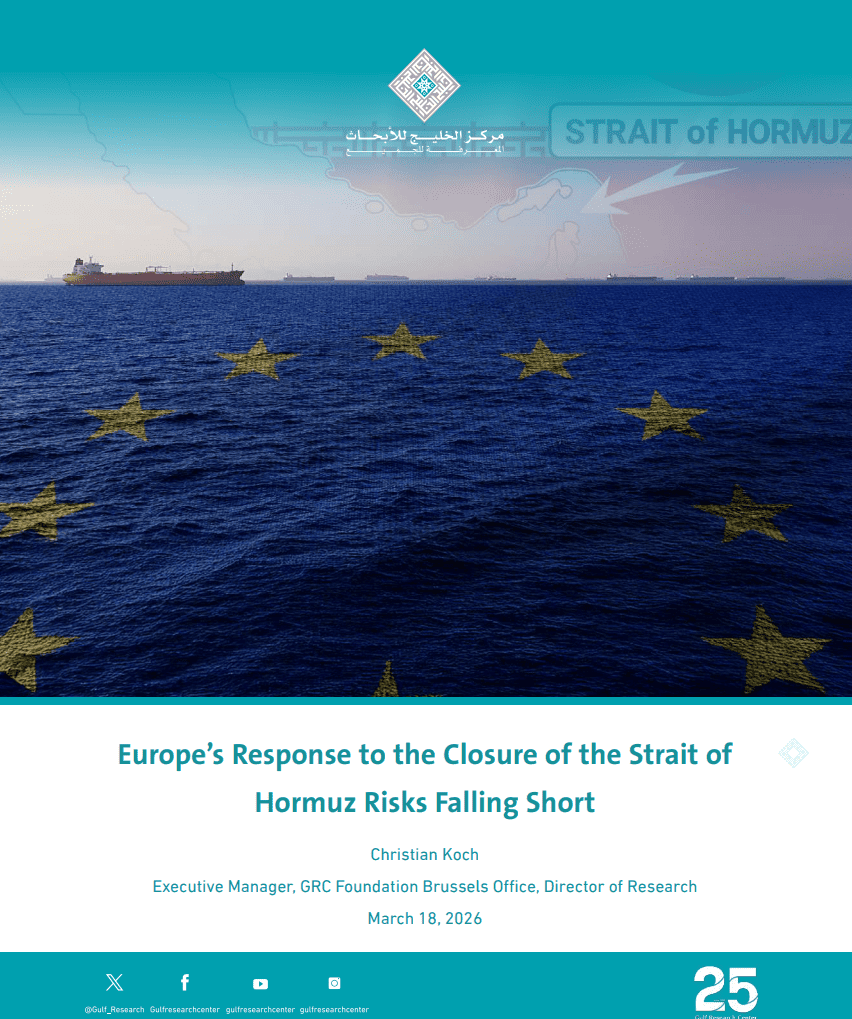
The global economy depends on uninterrupted maritime transport. According to shipping industry estimates, roughly 80–90% of world trade moves by sea. Within this system, a handful of strategic straits and chokepoints carry disproportionate volumes of cargo and energy flows.
The Strait of Hormuz is perhaps the most critical oil transit route in the world. Approximately onefifth of global petroleum trade passes through this narrow waterway linking the Arabian Gulf with the Gulf of Oman and the wider Indian Ocean. Any disruption in this strait directly impacts global energy markets, as is currently being witnessed in the U.S.-Israeli war on Iran.
Within days of the eruption of conflict, oil prices rose dramatically, by nearly 100 percent, to top the $100 a barrel mark. The International Energy Agency (IEA) stated that war in the Middle East is creating the biggest oil supply disruption in history with global supplies expected to drop by 8 million barrels a day in the month of March 2026 alone. For the European Union (EU), maritime security is thus not only a matter of foreign policy but also of economic survival. Europe relies heavily on seaborne trade and imported energy supplies from the Middle East and Asia. Consequently, instability in these maritime corridors can quickly translate into disruptions to supply chains, energy shortages, and inflationary pressures across European economies.
Taken together, there is an imperative to safeguard freedom of navigation and ensure the stability of global energy supplies. In this context, the Arab Gulf states would like to see the EU or European states more broadly, commit themselves to a robust response to the current crisis in the Strait of Hormuz. Simple declarations of intent, in the view of the GCC, fall short.
The EU has gradually developed capabilities to protect maritime trade routes. This includes the EUNAVFOR Operation ATALANTA, launched in 2008 to combat piracy off the coast of Somalia, the European Maritime Awareness in the Strait of Hormuz (EMASoH) initiative launched in January 2020 designed to protect freedom of navigation and improve maritime situational awareness in the Strait of Hormuz and the wider Gulf region, and most recently, the EUNAVFOR Operation ASPIDES from 2024 to respond to escalating attacks on commercial vessels in the Red Sea. EMASoH combines diplomacy with a military track called Operation AGENOR, headquartered at the French naval base in Abu Dhabi. It is not a broad EU operation but rather a European effort that includes Belgium, Denmark, France, Germany, Greece, Italy, Netherlands, Norway, and Portugal. The EU’s first reaction to the current disruption in the Strait of Hormuz has been diplomatic with European leaders stressing that critical waterways must remain open and that freedom of navigation must be respected. In an official statement, the EU’s High Representative Kaja Kallas warned that “the disruption of critical waterways, like the Strait of Hormuz, must be avoided.”
The EU also launched intensive diplomatic coordination with regional partners. European Commission President Ursula von der Leyen and European Council President António Costa held consultations with Middle Eastern leaders to discuss the impact of the Strait of Hormuz closure on global energy markets, and the risks to maritime security and trade routes. The EU coordinated positions with the GCC states to address attacks on energy infrastructure and shipping. In a statement released after the extraordinary EUGCC Joint Ministerial Meeting held on March 5, 2026, ministers from both sides “recognized the importance of EU maritime defensive operation ASPIDES and operation ATALANTA to protect critical waterways and reduce disruption to supply chains and encouraged coordination for the support of the operations.”
In the same vein, initial responses have even included suggestions that the EU could consider strengthening its naval presence and maritime security operations in the region including discussions on the creation of naval escort missions for tankers and commercial vessels. France, in coordination with European partners, announced plans to deploy additional naval assets and organize escort operations for ships transiting the Strait of Hormuz once conditions allow for safer navigation. These escort operations would involve European frigates and destroyers, maritime patrol aircraft, as well as coordination with allied navies in the Gulf. The overall objective would be to reopen shipping routes while minimizing escalation.
Following President Trump’s call for nations to assist in the full re-opening of the Strait of Hormuz, European nations have, however, backtracked. While the resistance to a potential NATO operation in the Gulf can be understood in the sense that NATO is a defense and not an offensive alliance, statements such as those by German Defense Minister Boris Pistorius, arguing that due to the fact that “this is not our war,” there would be “no military participation” from his country or positions such as those of Italy and Greece that they would not engage in any military operations in the Strait of Hormuz, have not been received well by the EU’s GCC allies. Statements such as those of Danish Foreign Minister Lars Lokke Rasmussen that the EU must decide on a plan “with a view towards de-escalation” and that Europe should keep an open mind on helping to ensure freedom of navigation in the strait even if the continent did not support the U.S.-Israeli decision to go to war with Iran are more in line with what the GCC states want to hear.
What has been missing from the current equation is a clear signal from the EU side about what Europe is willing to do to ensure that the principle of the freedom of navigation is assured and that the actions by Iran on the Strait of Hormuz are reversed. Just a rejection of the suggestions put forward by President Trump in this context are insufficient. Thus, within the context of the EUGCC Strategic Partnership launched in 2022, the consideration of an expansion/adaptation of the Operations ASPIDES or EMASoH should receive immediate, utmost attention.
Executive Manager, GRC Foundation Brussels Office, Director of Research