

Commentary & Analysis
Strategic Concerns and the Future Trajectory of GCC-U.S. Relations
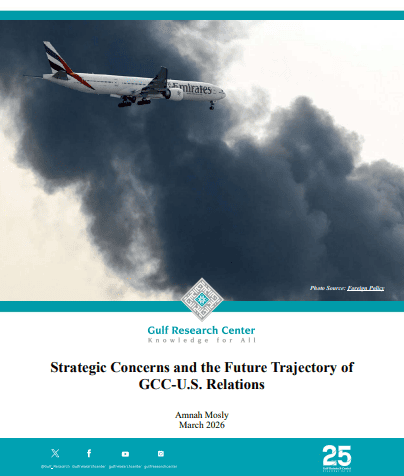
For decades, Gulf security doctrine has relied on close strategic alignment with Washington, anchored in defense cooperation agreements and access to capabilities intended to deter regional threats. Yet recent regional developments, particularly escalating tensions involving Iran, have prompted difficult questions in the region regarding the effectiveness, responsiveness, and consultative nature of the current policies.
At the operational level, concerns center on deterrence credibility. Despite security arrangements, recent hostilities and direct attacks on the region have exposed the limits of existing frameworks. The expectation that U.S. deterrence, coupled with advanced defensive systems, would prevent escalation or shield regional partners from direct threats has not been fully realized. In other words, the scale and frequency of hostile actions targeting the region, in particular the multitude of Iranian missile strikes and drone attacks, have raised questions about whether existing defense postures, coordination mechanisms, and response thresholds are adequate to deter state and non-state threats.
Equally significant are political concerns related to decision-making processes. There is a growing perception that U.S. decision-making has not adequately taken into account the security, safety, and strategic interests of Gulf states. Major decisions appear to be taken without meaningful consultation with regional partners. This concern is reinforced by a broader historical pattern. Several pivotal U.S. policy decisions over the past two decades have been viewed in the Gulf as insufficiently attentive to regional perspectives. In addition to the current conflict with Iran, which came as a surprise to the GCC states, the 2003 intervention in Iraq and the 2015 nuclear agreement with Iran stand out as other examples frequently cited in regional discourse. In both cases, it was perceived that Gulf security concerns were not adequately incorporated into the policy process.
Taken together, these incidents point to a deeper structural issue: the need for more inclusive and balanced consultation mechanisms in U.S. strategic decision-making, particularly when such decisions carry direct implications for Gulf security. The issue is therefore not limited to immediate crisis management but relates to the architecture of dialogue, coordination, and shared strategic assessment. In light of the conflict involving Iran, Gulf foreign and defense policies are likely to evolve across three interconnected levels.
First, strengthened national defense capabilities. There is an increasing recognition that reliance on external security guarantees alone is insufficient. Gulf states are likely to place greater emphasis on developing their national defense capacities, including through investing in domestic military industries, diversifying arms procurement channels, and reassessing force structures to better respond to evolving threats. The objective is to enhance strategic autonomy while maintaining flexibility in partnerships. A stronger national base is seen not as a substitute for alliances but as a stabilizing foundation that enables more balanced cooperation.
Recent regional developments have intensified these concerns. Saudi Arabia’s Foreign Minister, H.H. Prince Faisal bin Farhan, warned that the Kingdom’s restraint in the face of escalating Iranian attacks “is not unlimited,” signaling that military action remains on the table as Arab and Islamic states issued a unified call for Tehran to halt its aggression. He stated that the Kingdom and its partners possess significant capabilities and emphasized that patience should not be interpreted as passivity. He further noted that Saudi Arabia reserves the right to take military action if deemed necessary, while stressing that diplomacy remains preferable. At the same time, he warned that continued escalation would carry political and moral consequences and that the limited trust rebuilt with Tehran following the 2023 restoration of diplomatic ties has been severely damaged.
Such statements reflect a broader regional posture that combines restraint with preparedness, and diplomacy with deterrence. They also underline the seriousness with which Gulf states assess the current threat environment and the expectation that security partnerships should translate into credible protection and coordinated strategy.
Second, advancing collective security at the GCC level. The current context underscores that the threat environment is no longer confined to individual states but is shared across the region. The traditional model, characterized by limited coordination and largely national approaches to defense, is becoming less viable. This moment may serve as a catalyst to revisit and strengthen the GCC’s collective defense framework, deepen military integration, and enhance coordination mechanisms as a means to reinforce regional deterrence. Greater interoperability, joint planning, and shared early warning systems would represent practical steps toward a more cohesive regional posture.
Dr. Anwar Mohammed Gargash, Diplomatic Adviser to the UAE President, has called for a more unified command amid the ongoing escalation. In a post on his X account, he stated:
Iran’s brutal aggression against the Arab Gulf states carries profound geopolitical implications, establishes the Iranian threat as a central focus of Gulf strategic thinking, and reinforces the distinct nature of Gulf security and its independence from traditional concepts of Arab security. Iran’s missiles, drones, and aggressive rhetoric are all part of this. The result is a drive to strengthen our national capabilities and joint Gulf security, and to deepen our security partnerships with Washington. This is the price of Iran’s miscalculations.
Third, recalibrating the role of international partnerships. The United States is likely to remain a central security partner, particularly in advanced defense technology, intelligence cooperation, and extended deterrence. However, Gulf states are also likely to expand and diversify their external engagements. Defense procurement, technology transfers, and strategic dialogue with other major powers are becoming more prominent features of Gulf diplomacy. However, such relationships will complement rather than replace existing security arrangements, reflecting a broader strategy of diversification rather than dependence.
Taken together, these three levels point toward a more layered and balanced approach: combining enhanced national capabilities, stronger regional cooperation, and diversified international partnerships. It is important to note that this trajectory does not signal disengagement from the United States, as Gulf states continue to view the United States as a pivotal strategic actor. Rather, it reflects a maturing strategic outlook in which Gulf states seek to align external partnerships with growing national capabilities, regional responsibilities, and a shifting global order to adapt to a more complex and uncertain security environment.
*Amnah Mosly is a Researcher at the Gulf Research Center (GRC)