Commentary & Analysis
Alignment in a Brave New World? EU-ropean Strategic Autonomy and the Gulf Cooperation Council
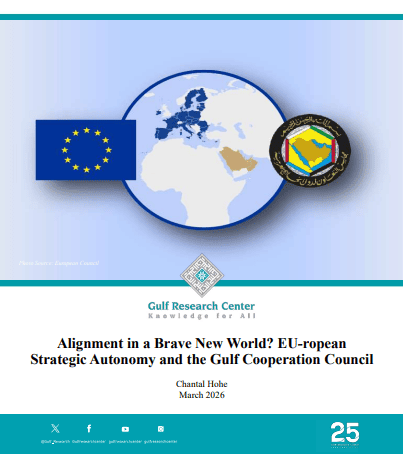
A middle power striving for strategic autonomy, the European Union is working to diversify its partnerships amid a multitude of unexpected and unprecedented challenges. Brussels has been prompted to rethink key aspects of its foreign policy approach amid an increasingly volatile geopolitical environment including a transatlantic partnership that is deteriorating by the day. Russia’s war of aggression against Ukraine, now past its four-year mark, shattered the illusion of stability on the European continent, while the fallout of Israel’s war in Gaza and the recent USIsraeli strikes on Iran put the fragility of maritime trade routes on display and underline the critical need to forge new pathways connecting global and European markets and safeguarding Europe’s supply lines. The EU failed to anticipate the aberrations in American foreign policy under the current administration, including not only arbitrary collective economic punishment but also explicit threats to the territorial integrity of an EU member state. In short, the rules-based international order is unravelling before Brussels’ very eyes - and the Union has not shown the foresight necessary to mitigate the consequences of this profound transformation.
Quite fitting in response to these challenges, but not yet fully operational, the EU’s primary foreign and security policy objective is to enhance its strategic autonomy. This entails freely setting priorities, making decisions, and implementing policies. Becoming an actor on the global stage that sets, adapts, and enforces rules and frameworks rather than merely playing by those designed by others. Well before Russia’s invasion of Ukraine, leaders such as Spanish Prime Minister Pedro Sánchez and then-Dutch Prime Minister Mark Rutte advocated for a more autonomous Union. The European Commission has also sought to make the EU more geopolitical, more vocal, and more united in its external action - positioning Brussels as a crucial actor in upholding the rules-based order and engaging new players. Under the banner of principled pragmatism, the objective is safeguarding and promoting the EU’s core principles while pursuing pragmatic policies and partnerships that address root causes of conflict, advance prosperity, and contribute to an outward- and forward-looking foreign and security policy.
Against this backdrop, the Gulf Cooperation Council and its resource-rich, affluent, and increasingly influential member states bear growing strategic significance for the EU. Their relative stability, diplomatic astuteness, and diverse partnerships spanning different geopolitical ‘teams’ set the Gulf states up as potential enablers of Brussels’ geostrategic posture and diplomatic access. As negotiations for Strategic Partnership Agreements (SPAs) between the EU and individual Gulf states gain momentum, questions remain about how to move beyond dialogue and toward the implementation of joint initiatives. Hopes are high that the current international context can serve as a catalyst for deeper engagement and coordinated action within the framework of the Joint Action Programme and the proposed SPAs. Yet, strengthening the image of partnership alone will not suffice. Gulf states are increasingly vocal in their expectation that European commitments be followed by concrete initiatives. Policymaking in Brussels, however, remains complex, slow, and conditioned upon unanimity.
Bringing these partnerships onto a solid institutional footing will be anything but straightforward. There is no one recipe for success, but establishing certain preconditions will help. The tailoring of each agreement needs to ensure agility in choosing which matters to prioritise according to current needs and developments, thereby also reflecting the mercurial state of affairs. Meanwhile, it needs to enable step-by-step confidence building, focusing first on matters where common ground is found more easily, and building up from there. Sectoral areas of mutual interest with the potential for alignment include trade and connectivity, energy security and the green transition, and more abstract but nonetheless crucial political issues and questions of peace and security in Europe and the wider Middle East. While several EU member states have cultivated bilateral ties with individual Gulf monarchies over the decades, EU-level engagement promises deeper integration of the EU-27’s external action while granting GCC members structured access to the Union as a whole. But promises, as is too often the case, are nothing more than a shell to be filled with life.
The Strategic Partnership Agreement: The new tool of choice? SPAs have gained in popularity as an instrument of cooperation in recent years. They can serve as guardrails for the external relations of states and international organisations. But not all partnerships are alike. They vary significantly in scope, commitment, and consolidation and oftentimes embody more sectoral, transactional cooperation than engagement bound by shared values and strong accountability measures. Whether in the form of a broad-based agreement like the one between Iran and Russia, a single-issue agreement like the Saudi-Pakistani defence pact, or the so-called comprehensive economic partnership agreements (CEPAs), which the UAE uses to procure partners globally, including Australia, Israel, and Türkiye - they all follow similar objectives: enhancing access, setting ground rules for interaction, and allowing for mutually beneficial cooperation without the need to enter into an
alliance. For the EU to leverage these diverse, issue-based partnerships, Brussels, too, must move beyond traditional alliance structures. Negotiating SPAs with the GCC member states reflects a broader willingness to engage actors across regions and political systems - from like-minded partners such as Canada to emerging actors in Southeast Asia, Latin America, and the Middle East.
In practice, however, the EU’s strategic partnership framework often lacks clarity. Distinctions between formal and informal arrangements are blurred, multiple diplomatic instruments are employed simultaneously, and implementation remains inconsistent. Disagreements among member states frequently stifle execution, particularly with partners outside the EU’s core helpmeets. The EU’s limited freedom of action in foreign policy further complicates matters. Unanimity requirements constrain flexibility and autonomy, even as the Commission seeks to strengthen both. The resulting tendency toward the lowest common denominator fuels doubts about the Union’s capacity to act decisively. Ultimately, Brussels’ external action remains subject to the final say - and the moods and political sensitivities - of the EU-27.
What the Gulf states need, and what they expect from Brussels The Gulf monarchies are cognisant of the EU’s frailties when it comes to foreign policy decision making and are keen to see their own SPAs unfold in a timely manner. Aware that the negotiations will take time as the EU-27 navigate legal, topical, and implementation-related questions, the Gulf states see this as the beginning of a longer process. The launch of negotiations alone was already viewed as a meaningful signal of commitment. Gulf expectations toward Europe must be understood within the context of their broader regional and foreign policy strategies, which are closely tied to regime survival and domestic stability. The GCC member states’ foreign policy is shaped by a tight integration of political and economic considerations, with power projection through financial and military strength. Their core priorities include a stable neighbourhood, diversified international partnerships, sustainable growth, and prosperity. Gulf states seek a stronger regional and global role, making region-to-region engagement a particularly attractive addition to stateto-state ties.
With the exception of Oman, these states are young. They have undergone rapid economic transformations, building export-oriented economies through the exploitation of hydrocarbon resources. The pursuit of material wealth through trade in general has a strong cultural and religious legitimisation in the Arab Gulf. Yet, economic strategy centred around fossil fuels alone carries high risks. Recognising these vulnerabilities, Gulf rulers have launched ambitious diversification initiatives, so-called ‘Visions’, with targets typically set between 2030 and 2040. These aim to create new sources of economic empowerment, strengthen the private sector, and diversify income streams. While the full extent of Gulf financial wealth remains opaque, these strategies offer external partners greater clarity regarding investment priorities and engagement opportunities. For the EU, they provide planning security and entry points in areas such as trade, investment, education, and technical expertise, particularly given the Gulf’s limited industrial base and skills shortages beyond the petroleum sector.
To achieve their ambitious objectives, the Gulf states require reliable partners. So does the EU as it grapples with an existential crisis linked to the war in Ukraine and seeks to strengthen its international posture as one of the sole remaining advocates for diplomacy and restraint. In theory, these interests align well. Both regions share a desire for stability, order, and predictability. Issue-based alignment offers a pragmatic foundation for EU-GCC cooperation, allowing both sides to identify areas of convergence without demanding full political or ideological alignment.
Trade-offs and risks in EU-GCC engagement Despite promising developments in EU-GCC relations, reconciling shared interest with closer geopolitical engagement remains a core challenge. Differences persist on issues ranging from Russia’s war in Ukraine, China’s growing role, the Israeli Palestinian conflict and the Iran issue, to human rights and basic freedoms within countries and the financing of militias and conflict parties for economic gain. Engagement should not be equated with endorsement, and conditioning increased cooperation on more ambitious human rights and rule of law agendas must remain an integral part of the relationship.
The GCC member states share the EU’s assessment that the post-World War II system of checks and balances has faltered. They seek to be part of a global system that is stable and suitable for doing business. The question is whether Brussels could be one of its key architects. The United States’ entrenched presence in the Gulf raises questions about the EU’s room for manoeuvre vis-à-vis a strategic partnership. GulfUS relations remain particularly strong in security and defence, underscored by extensive US military infrastructure across the region, and Washington still leading on political initiatives such as the latest Board of Peace for Gaza which all GCC member states with the exception of Oman are part of - and which does not include a single EU member state but instead saw Putin’s Russia join. While the ramifications of the US-Israeli led campaign ousting and killing Iran’s Supreme Leader are yet to be felt across the region and beyond, Brussels might emerge as the undefiled mediator.
As economic considerations increasingly shape geopolitics, trade, finance, and energy have become central arenas of competition, and promising access points for the EU. The Gulf states seek to deepen ties with partners that offer stronger regulatory stability and lower volatility. This is a key advantage for the EU. Sectorbased cooperation in finance, connectivity and green energy stand out as possible drivers of EU-GCC cooperation, as they are possibly less constrained by unanimity requirements and largely driven by private actors. Investments can be implemented more quickly and generate mutual benefits. However, such cooperation often remains project-based, perpetuating competition among EU member states and Gulf monarchies alike. These feuds complicate European engagement, as most recently illustrated by France’s entanglement in the Saudi-Emirati quarrel through its energy giant TotalEnergies in Yemen. Brussels ought to circumvent these intra-GCC rivalries, alongside existing dependencies and competition from the US, China and others. In tailoring the SPAs, a key challenge will be to accommodate each partner’s priorities without pitting one against the other.
Can the Gulf SPAs genuinely contribute to the EU’s Strategic Autonomy? The EU can no longer rely on trust alone in its external relations. As it pursues a more assertive foreign policy and seeks to diversify its partnerships, the GCC member states truly are valuable partners. They offer investment opportunities, a strategic location, and access. A viable basis for common ground between the EU and the GCC lies in approachability, trustworthiness, and competence - characteristics that Brussels embodies. The SPAs can become an instrument that facilitates cooperation between the different actors and streamlines processes that would otherwise be highly bureaucratised. Albeit a stronger degree of institutionalisation can be beneficial to drive lasting cooperation and build trust, the risks this carries are far from negligible. Should the SPAs fail to materialise, or should they fail to produce the tangible outcomes that both the EU and the Gulf states hope for, Brussels risks losing access in the wider region, remaining on the sidelines while jeopardising its credibility.
The EU-27 are ultimately the ones to decide how to go about building a partnership with the Gulf that contributes to advancing the EU’s strategic autonomy. For this to succeed, it is wise to start small, building consensus step by step instead of pursuing a broad-based agreement that risks coming to naught. Gauging the sensitivity and political nature of matters remains a key challenge, as seen with the visa liberalisation debate that has been ongoing for almost four years. Debate among member states is a key trait of EU decision making but can likewise be a spanner in the works and a risk to the credibility of Brussels’ intentions with the Gulf states. Competition from other actors, including the US and China, threatens the EU’s ability to position itself as a true alternative. But it does not need to be - rather, Brussels should embrace its uniqueness and leverage its economic, financial, and diplomatic capital while also not overestimating its geostrategic weight. As principled pragmatism guides EU foreign policy, safeguarding European values remains essential. Striking a balance between short-term issue-based cooperation and long-term strategic considerations will be decisive. Abandoning hierarchical partnership models and embracing reciprocity through formalised channels of communication could unlock progress. Strong partnerships will not emerge overnight, but if managed carefully, EU-GCC engagement can offer a platform grounded in cooperation, equality, and shared responsibility.
*Chantal Hohe is a Non-Resident Fellow at the Gulf Research Center (GRC).