Commentary & Analysis
The EU and the GCC: Promoting Regional Stability After the US-Israeli War on Iran
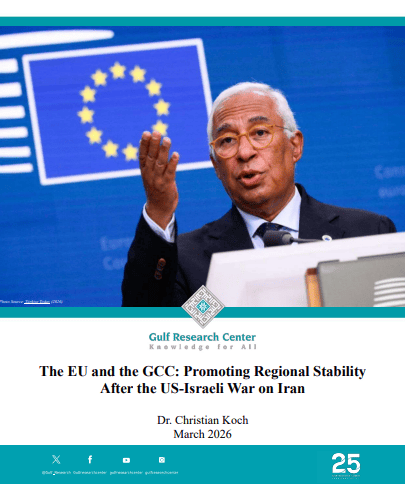
The latest escalation between the United States, Israel, and Iran, which has included targeted strikes on the Iranian leadership and infrastructure throughout the region, has thrown the Middle East into further disarray. The repercussions are immediate and far-reaching and include direct missile and drone strikes on GCC states as well as shattered assumptions about the limits of the conflict, and rising risks to civilian life, energy security, and global markets. European leaders immediately warned of the “significant fallout” to be expected. At the same time, they, alongside their GCC counterparts, have emphasized time and again the need for diplomatic solutions to bring the situation to an end.
The precise outcome of the current hostilities cannot be predicted, and the full extent of the repercussions remains unknown. To be sure, Europe will not play an immediate security role in resolving this crisis – it does not have the capabilities or the unity to do so. Rather, the more important focus is further down the road. As such, the crisis provides an opportunity, even an imperative, for extensive and constructive collaboration between the EU and the GCC states to begin forging a more stable regional order rooted in diplomacy, economic interdependence, security cooperation, and adherence to the multilateral rules-based international order.
The point of departure is that both Europe and the GCC have vital stakes in Middle Eastern stability. This includes the security of energy flows through the Strait of Hormuz for global oil and LNG exports, where the current disruption has already brought about significant price volatility. Prolonged conflicts also increase the risk of terror proliferation, a development that would further undermine Gulf and European security, as well as increase migration pressures, which is of particular concern for Europe. Moreover, the current crisis has diverted attention from the many other unresolved conflicts in the Middle East, from Gaza to Libya, Sudan, Syria, Yemen, and beyond, all of which are ongoing and require urgent solutions.
Prior to the outbreak of the most recent attacks, the GCC states had committed themselves to a broad regional de-escalation strategy. Alongside Europe, the GCC pleaded for a diplomatic off-ramp and “maximum restraint” until the very end. And despite the direct targeting of their infrastructure and societies, GCC leadership knows that, ultimately, the conflict can only be solved at the negotiating table. What GCC states lack regionally, however, are the strategic partnerships at the diplomatic level that can turn their intentions into operational leverage. Europe is instrumental in this regard.
EU-GCC collaboration and initiative could revolve around the following priorities: reviving and reframing diplomacy with inclusive mandates; deepening security cooperation beyond military postures; leveraging their economic and investment partnerships for stability; and championing a new normative order grounded in international law.
On the diplomatic front, a GCC-EU Middle East Peace Platform would work out incentives and guarantees that reduce the need for unilateral military action, including confidence-building measures through which trust can be rebuilt. There is a continued and urgent need for realistic diplomatic engagements that can deescalate tensions and create spaces for negotiated solutions to broader problems, including nuclear proliferation and geopolitical security guarantees. Structured negotiation tracks and supporting backchannel diplomacy are options to consider. This could ultimately include efforts for re-engagement with Iran, but also reinvigorating urgent action on Gaza and the Palestinian issue, for example. In this context, Europe needs to amp up its convening power.
In terms of security cooperation, the current conflict illustrates that unilateral reliance on external powers, including the United States, for security is not a surefire solution to the Gulf security dilemma. GCC states are already weighing possible alternative defense partnerships, signaling their frustration with traditional guarantors. In this context, a GCC-EU security relationship would include a concept for integrated maritime security, such as a mandated EU-GCC naval task force to protect commercial shipping, joint early warning systems for missile detection and threat assessment, and shared training and capacity-building measures, including European expertise on peacekeeping, civil defense, and infrastructure protection. The idea here is not power projection but creating a security interdependence that deters escalation.
Economic integration, meanwhile, can be a powerful stabilizer. The GCC’s economic diversification efforts, including investments in technology and non-oil sectors, dovetail with European interests in energy transition and industrial innovation. As a result, initiatives could include deeper energy partnerships, projects promoting infrastructure connectivity in energy, logistics, digital trade, and financial services, as well as educational and cultural exchanges, as building blocks for longterm stability. This aspect would seek a peace dividend with tangible benefits that accrue from stability rather than conflict and war.
Finally, Europe’s identity as a proponent of international law and multilateral norms is essential in realigning the Middle East away from unilateral military approaches and towards rules-based conflict resolution. Encouraging adherence to humanitarian law and supporting accountability and justice mechanisms is fundamental to creating a regional order that prizes legitimacy and predictability. The EU and the GCC can spearhead discussions and provide platforms that can serve as examples for others to follow.
The current war between the US, Israel, and Iran has amplified the fragility of the existing Middle Eastern order. Europe might not want to play the role outlined above, but as EU officials have clearly stated in recent years, Gulf security and European security are clearly linked. And while there is no imminent end to the crisis, it is never too early to think about what comes next. In the framework of the EU-GCC strategic partnership, there is a window for creative realignment focused on diplomacy, security interdependence, economic integration, and normative governance. Given that neither Europe nor the Gulf has been able to insulate itself from the repercussions of regional conflict, there is also a responsibility to help foster an alternative that is more stable and anchored in inclusive, predictable frameworks.
Dr. Christian Koch is the Executive Manager, Gulf Research Center Foundation Brussels, Director of Research, Gulf Research Center