

Commentary & Analysis
Operation Epic Fury Ceasefire: Ten Action Points for Water Crisis Management
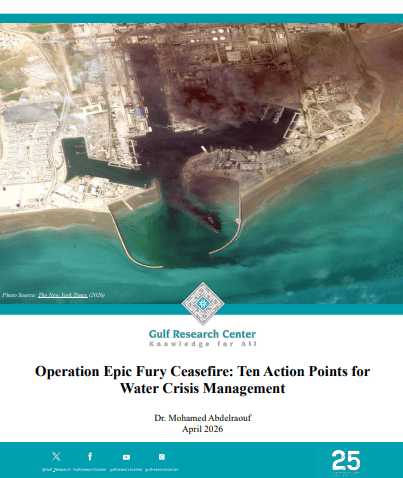
The ceasefire agreed to on April 8, 2026, marks a critical pause in active hostilities. Yet the Operation Epic Fury campaign has already left a "toxic legacy" that will require decades to recover from. While the conflict has severely compromised the region’s natural resources, the impact has been especially heavy for its most vital one - water.
The conflict has demonstrated a dangerous trend in modern warfare: the weaponization of water infrastructure. By targeting desalination facilities, parties to the conflict are pursuing strategiesthat risk a regional humanitarian catastrophe. This is a highly unethical act that all religions forbid. Common across all faiths is the protection of environmental assets during times of military conflicts. Moreover, such violations are deemed war crimes under international law, as are attacks on wider oil and electricity infrastructure.
Water Infrastructure Under Attack
The Gulf Cooperation Council (GCC) countries rely on desalination for up to 90% of their drinking water. Experts warn that if major desalination plants were to be fully disabled, some Gulf cities could face a humanitarian crisis within a week, necessitating mass evacuations. The likelihood of such a scenario must be taken seriously.
The conflict between the U.S./Israel and Iran has led to several attacks on critical water desalination infrastructure in the Arabian Gulf region, raising significant humanitarian and environmental concerns. On March 2, 2026, the Doha West Power and Water Desalination Station in Kuwait was damaged by debris from intercepted drones and missiles. Then, on March 8, 2026, Iran-backed forces allegedly targeted a desalination center in Bahrain with a drone, causing material damage. Subsequent attacks, including Iranian drone strikes on April 5, 2026, caused "significant material damage" to Kuwaiti power and water infrastructure, taking two power generators offline.
Many crucial components, such as pumping stations and filtration units, are exposed, making it difficult to defend them against drones and missiles. In addition, the oil spills from targeted tankers have threatened the shutdown of desalination intake systems across the region and significantly increased their cost of operation. Moreover, the destruction of alternative water and sewage facilities now risks widespread outbreaks of waterborne disease.
Ceasefire: What Comes Next in Terms of the Environment
The GCC Emergency Management Center (GCC-EMC) responded to many of the attacks by activating its regional monitoring systems for environmental, radiological, and water contamination, providing technical support and coordinating damage assessments, with a particular focus on protecting vital desalination plants. They were thus able to mitigate risks from infrastructure damage, such as oil spills and water supply disruption, to secure critical civilian infrastructure.
To further counter the very real, and potential, dangers that affect the region’s environment, GCC governments should use the ceasefire period to consider implementing the following 10-point action plan to stabilize water resources and mitigate environmental collapse in the Gulf:
1. Environmental Decontamination and Monitoring
The conflict has left a "toxic legacy" that must be fully mapped and contained before it spreads further into the ecosystem.
2. Emergency Water Infrastructure Restoration
With many Gulf states relying on desalination for up to 90% of their drinking water, immediate technical repairs are critical to prevent any further deterioration or displacement.
3. Power Grid Reconnection
Desalination plants are often integrated with power facilities; reconnecting these "critical national security infrastructure" nodes is essential for both water and electricity.
4. Securing Emergency Reserves
Activate and protect strategic water reservoirs and aquifer recharging systems to provide a buffer for GCC cities.
5. Wastewater Management
Immediately halt the discharge of untreated wastewater into the sea to prevent further contamination of marine environments and drinking water intakes.
6. Marine Pollution Containment
Deploy emergency booms and skimmers to contain oil spills and chemical leaks in the Arabian Gulf that threaten desalination intake systems and sensitive coral ecosystems.
7. Industrial Site Stabilization
Secure bombed industrial and chemical sites to prevent leaching of "forever chemicals" (PFAS) and explosive compounds into urban and rural groundwater.
8. Implement Water Rationing
Rapidly deploy coordinated regional rationing plans, potentially reducing per capita daily use from 550 liters to an emergency level of 180 liters to stretch remaining supplies.
9. Water Access Rights
Use the ceasefire to strictly defend the international right to access water, preventing it from being used as a "military objective" in future escalations. Ensure “Water Access Rights” in any future permanent war stop agreement.
10. Regional Cooperation
The ceasefire period is the time to utilize all communication channels to urge an end to attacks on such infrastructure, and then, as a measure after a permanent end to hostilities is agreed upon, to discuss regional cooperative steps. Ultimately, this needs to be part of the wider regional security discussion including coordinating with all countries of the Gulf, including Iran and Iraq, in data and information sharing and down the road in possible joint water projects. Such types of regional cooperation will serve as a pillar for regional stabilization.
Conclusion
Following the military operations in March and early April, the situation remains fluid, with ongoing retaliatory strikes on infrastructure still a possibility. Yet, even as military operations slow or stop altogether, the environmental repercussions of the crisis will not end immediately. Repairing desalination technology is a long-term project requiring specialized personnel and components. With the supply chains for key parts in the Gulf disrupted, restoring full capacity could take months or even years. There is no doubt that this conflict has set a dangerous precedent, in which water infrastructure is treated as a strategic target, threatening long-term insecurity for the region's water supply. The targeting of desalination plants has shown that water is now a primary weapon of war. While GCC countries have demonstrated resilience by leveraging existing infrastructure, the long-term impact on water supplies has accelerated the need for, and development of, strategic reserves, such as groundwater recharge and treated sewage effluent (TSE) projects, to reduce dependency on vulnerable coastal desalination sites.
Dr. Mohamed Abdelraouf is the Director of the Environmental Security and Sustainability Research Program at the Gulf Research Center.