Commentary & Analysis
GCC SADC Relations
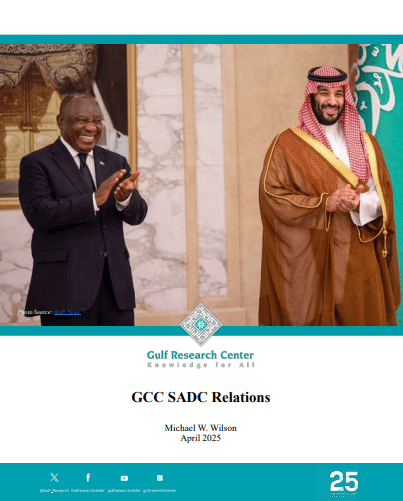
Over the last few years, and amid expanding geopolitical disruptions, economic and diplomatic relations between the Gulf Cooperation Council (GCC) countries and the Southern African Development Community (SADC) – a 16-member state regional economic community that includes Angola, Botswana, the Democratic Republic of the Congo, South Africa, and Mozambique, among others, have grown steadily. In 2024, GCC-SADC trade volumes reached USD 38.6 billion, up from USD 32 billion in 2022.
This growth is driven by several policy shifts, including the signing of Comprehensive Economic Partnership Agreements (CEPAs) between the UAE and key SADC states such as Mauritius, Mozambique, and Angola, as well as expanded Memoranda of Understanding across critical sectors with Saudi Arabia, Qatar, and Oman. Policy shifts within the GCC, such as national economic diversification agendas, including Saudi Vision 2030 and the UAE's economic strategies, have prioritized foreign investment and trade expansion with emerging markets.
On the SADC side, economic reforms and new investment frameworks have aimed to attract Gulf capital. Gulf countries are focusing on more strategic and economic partnerships with SADC countries, as global uncertainties have exposed the Gulf's vulnerability to agricultural imports. While SADC countries have great agricultural potential, trade flows focus on a few raw commodities.
Gold, diamonds, and copper were the leading exports from SADC to the Gulf states, underscoring the GCC’s push for critical minerals. While these contribute to rapid trade growth and volumes, they do not lead to industrial integration or value chain development in SADC. On the other hand, GCC exports mainly consist of fuels and petrochemicals, underscoring Africa's dependence on energy imports.
At the same time, the relationship is becoming more strategic. GCC countries are increasingly viewing SADC as a source of critical commodities and as a long-term investment destination. They are focusing on energy, infrastructure, agriculture, and critical minerals, aligned with Gulf diversification strategies and food security priorities. Meanwhile, SADC countries are positioning themselves as investment destinations for Gulf capital, targeting sectors that require large-scale financing and technical expertise.
What Has Worked Well
One of the most effective factors of GCC-SADC relations has been the expansion of targeted, sector-specific investments. Angola represents a leading example of this investment model. The UAE has established a comprehensive partnership through a USD 6.5 billion investment package spanning infrastructure, agriculture, mining, and technology. The agreement includes modernization of the Luanda Port through a 20-year concession. Saudi Arabia has pledged over USD 300 million in infrastructure, particularly related to the mineral-rich Lobito Corridor. Whereas Oman has acquired stakes in Angola’s Catoca and Luele diamond mines. These initiatives illustrate how coordinated investment, infrastructure expansion, and resource partnerships strengthen bilateral relations.
The UAE, Qatar, and Saudi Arabia are particularly keen to contribute to the energy transition and must secure minerals to do so, such as copper. The DRC and Zambia are home to vast copper mines, which Gulf investors are increasingly targeting. For instance, the Qatar Investment Authority acquired a USD 500 million stake in Ivanhoe Mines, which operates several mines across the DRC.Qatar is an increasingly active investor across SADC, signaling a strategic shift in its foreign investments. It has committed USD 20 billion in Mozambique, USD 19 billion in Zambia, and USD 12 billion in Botswana to target infrastructure, energy, mining, agriculture, and digital sectors.
Qatar Energy has also taken on LNG projects in Mozambique and Namibia, underscoring its agenda on the continent and helping these countries unlock their energy potential. Qatar has partnered with Eni to explore gas reserves in Mozambique’s Angoche basin and aims to be operational by 2027, demonstrating its progress on its investments.
The UAE has invested over USD 3 billion in Mozambique, including DP World’s operation of the Port of Maputo and renewable energy projects, while discussions toward a CEPA signal a move toward institutionalized trade relations. In the DRC, UAE-linked firms are investing in copper, cobalt, and tin supply chains, including refinery development and mining acquisitions, positioning the Gulf as a key player in global critical minerals markets.
Development finance is a key instrument in shaping the relationship between the GCC and SADC. Institutions such as the Saudi Fund for Development and the Kuwait Fund have also supported projects in sectors including transport, agriculture, water, and energy in Malawi, Tanzania, Mozambique, and Madagascar. These initiatives have facilitated long-term engagement, established pathways for private sector investment in the Gulf states, and built positive rapport.
The GCC and SADC have formed several joint business councils that, over the years, have highlighted priority sectors for investment and matched them with Gulf interests. These exchanges reveal the needs of SADC countries and enable the private sectors from SADC and the Gulf to cooperate. For instance, the UAE, Qatar, and Saudi Arabia have joint business councils with Mozambique, Angola, South Africa, and Tanzania. These have facilitated bilateral economic relations and helped implement investment strategies.
Commercial frameworks are important in making this relationship succeed. For instance, the UAE has signed CEPAs with Mauritius, Mozambique, and Angola, aiming to boost trade relations. In Angola, for example, trade was USD 4.2 billion in 2022 and is expected to grow to 10 billion USD by 2033. The logistics centers, such as Dubai Industrial Park, which will host storage facilities and supply chain processing, and the Luanda Port that it operates, will all contribute to expanding trade, improving storage quality, and making trade more efficient. MoUs are also important for establishing these relations, as Oman, Qatar, and the other Gulf states have signed them to strengthen cooperation across various fields. These help formalize and structure the economic relations.
Recent years have seen a notable increase in presidential visits, ministerial exchanges, and formal agreements:
- UAE President Sheikh Mohamed bin Zayed Al Nahyan’s visit to Angola (2025) reinforced strategic cooperation in trade and infrastructure.
- Angola’s President João Lourenço’s visit to Oman (2024) led to new investment and energy agreements.
- Qatar’s Emir Sheikh Tamim bin Hamad Al Thani conducted a state visit to the DRC (2025), expanding political and economic cooperation and supporting mediation efforts.
- Mozambique’s President Daniel Chapo conducted a working visit to the UAE (2026) to mobilize investment in strategic sectors.
- South Africa’s President Cyril Ramaphosa visited the UAE in 2026, further institutionalizing bilateral cooperation.
Areas to Improve
Despite these positive developments, GCC-SADC relations remain constrained by institutional weaknesses. Understanding these gaps is essential for charting a more balanced and diversified partnership going forward.
First, the relationship is overly dependent on raw commodity exports. Over 80% of GCC imports from SADC are concentrated in a few products, particularly gold, diamonds, and copper. While this supports trade growth, it simultaneously limits opportunities for industrialization, value addition, and job creation within SADC economies. Moreover, in some cases, raw materials are exported to the Gulf, processed, and re-exported globally, which reduces the value captured by African producers.
The UAE is Africa’s largest exporter of critical minerals among the Gulf states, including gold, copper, and diamonds. While this is good for trade volume, the UAE imports raw materials and refines gold in Emirati refineries before reselling it to the global market. This provides certain advantages to African exporters who have access to a wide and reliable network of commodity traders based in Dubai.
However, it will be important to refine critical minerals in Africa to increase government revenues. It will also contribute to capacity building and promote job creation. If the UAE or other Gulf states continue to export raw materials, they risk being accused of taking away natural resources and enriching themselves while undervaluing African exporters.
SADC countries also have significant agricultural potential that can help address food insecurity in the Gulf states. The urgency for food security underscores the Gulf push to invest in agricultural companies or acquire farmland in the SADC region. In 2026, the Saudi Agricultural and Livestock Investment Company took a controlling stake in Olam Agri, a Singapore-based agribusiness operating across multiple African countries. This move aims to bolster Saudi Arabia's domestic food security strategy. By investing in a company with established operations in markets such as Nigeria, Ghana, Senegal, and Mozambique, Saudi Arabia is securing access to agricultural supply chains abroad to help meet domestic agri-food needs.
However, Gulf states could face criticism that the products are exported to them with little benefit for the exporting country, where food inflation can rise rapidly. Therefore, African governments should ensure that, through Gulf investments, productivity is increased, costs are lowered, and sufficient production is achieved to satisfy domestic demand, and then sell the excess to other Gulf partners.
Second, engagement across the GCC is uneven and fragmented. The UAE dominates trade and investment flows, while Saudi Arabia is emerging as a strategic partner, and Qatar is rapidly expanding its presence. In contrast, Kuwait and Bahrain remain largely confined to development finance and limited bilateral initiatives. This lack of coordination reflects the absence of a coherent GCC-wide strategy toward SADC, limiting the overall impact of Gulf engagement.
Fourth, connectivity and logistics constraints continue to hinder trade expansion. While Gulf actors such as DP World are investing in ports and logistics infrastructure, regional integration within SADC remains incomplete, particularly for landlocked countries such as Zambia and Zimbabwe. Limited transport corridors and high logistics costs reduce the efficiency of trade flows.
The Way Forward
Looking ahead, GCC-SADC relations will need to evolve from a transactional, commodity-driven model to a more integrated, strategic partnership.
A central priority is value addition within SADC economies. Rather than exporting raw minerals and agricultural products, there is a need to develop:
- Mineral processing and refining industries
- Agro-processing and food value chains
- Industrial zones linked to logistics and export infrastructure
To address these limitations, targeted policy interventions should be considered. Both sides could introduce incentives for joint ventures in value-added sectors, support technology transfer schemes, and require a portion of mineral refining or agro-processing to occur within SADC countries. Establishing public-private investment platforms, facilitating cross-border industrial zones, and launching skills development programs would further encourage local industrialization.
Additionally, aligning customs, tax incentives, and investment protections could make it easier for Gulf investors and SADC partners to create integrated supply chains that benefit both regions.
At the same time, institutional frameworks must be strengthened. Expanding resident diplomatic missions, establishing joint economic councils, and formalizing cooperation through agreements such as CEPAs will be essential to sustaining longterm engagement and improving coordination.
To address this, a practical next step would be to establish a GCC-SADC coordination framework. This could include forming a dedicated GCC task force or working group focused specifically on SADC relations, with representatives from each member state, to harmonize priorities, share best practices, and coordinate investments. Developing a joint GCC-SADC strategy or action plan would also help align objectives and pool resources, enabling more consistent and impactful engagement across the region.
Private sector participation will also be critical. While sovereign wealth funds and development finance institutions have driven initial engagement, the next phase will depend on greater involvement from private companies and financial institutions, supported by business councils and investment platforms. Policymakers could enable this by introducing targeted incentives such as tax breaks or reduced tariffs for joint ventures and SME partnerships, simplifying business registration processes for cross-border investors, and establishing credit guarantee schemes to reduce risk for local and Gulf-based SMEs. By implementing these policies, both regions can foster a more robust private-sector ecosystem and ensure broader participation in trade and investment opportunities.
Finally, improving connectivity and regional integration will be essential. Expanding air routes, strengthening logistics corridors, and supporting SADC’s regional integration agenda will reduce trade costs and unlock new investment and industrial cooperation opportunities.
Michael W. Wilson is a Researcher at the Gulf Research Center