

Commentary & Analysis
The Trump-Xi Beijing Summit: Crisis Management Hormuz, and the Limits of Chinese Leverage
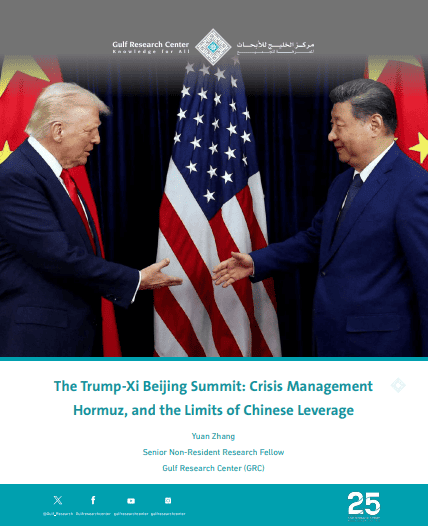
Context and Stakes
President Donald Trump will be in Beijing from 14–15 May 2026 marking the first visit by a sitting US president to China in nearly a decade. The summit was originally scheduled for late March but was postponed by roughly six weeks after the United States and Israel launched Operation Epic Fury against Iran on 28 February.1 The summit therefore takes place against a backdrop neither leader anticipated when they agreed to a trade-war truce on the margins of APEC in Busan last October: an active Middle Eastern war, a partially blockaded chokepoint through which roughly a fifth of seaborne oil and LNG normally transits, and a fragile dual-blockade equilibrium in which the US Navy is simultaneously interdicting Iranian ports while Iran selectively permits transit through Hormuz on payment of seven-figure tolls.
This context fundamentally reshapes what the summit can be expected to produce. In a calmer year, a Trump-Xi meeting would have been about managing the structural rivalry: semiconductors, Taiwan, industrial subsidies, and the question of whether the Busan truce can be hardened into something durable. Those issues have not disappeared, but they will be refracted through the more immediate question of whether China, the world’s largest oil importer, and the US, now prosecuting a war against one of China’s major crude suppliers, can find a coordinated exit ramp.
What Each Side Wants
1 - Reuters, “Trump Postpones Trip to Beijing as Iran War Delays China Reset,” 17 March 2026; Reuters, “Iranian Leader Khamenei Killed in Air Strikes as U.S., Israel Launch Attacks,” 28 February 2026.
2 - Reuters, “Oil Tankers Transiting Strait of Hormuz Since Start of Iran War,” 29 April 2026; Reuters, “Mitsui O.S.K. Says Its Vessels Did Not Pay Fees Transiting Hormuz,” 8 May 2026; International Energy Agency, “Strait of Hormuz.”
For Trump, the summit serves three overlapping purposes. First, it allows him to demonstrate that he can stabilise the world’s most consequential bilateral relationship while simultaneously running a war, a useful domestic narrative ahead of the American midterm elections, particularly as US fuel prices have risen sharply. Second, it offers a chance to extract Chinese leverage over Tehran. Treasury Secretary Scott Bessent’s 4 May intervention, accusing China of ‘funding the largest state sponsor of terrorism’ through its purchases of roughly 90 percent of Iran’s energy exports while simultaneously asking Beijing to ‘step up with some diplomacy,’3 captures the awkward dual register of the US ask. Third, the summit offers an opportunity to lock in the trade architecture sketched in Busan: continued Chinese rare-earth exports, agricultural and Boeing purchase commitments, and the bilateral ‘Board of Trade’ (and possibly a parallel ‘Board of Investment’) that Jamieson Greer has been negotiating in Paris.
For Xi, the calculus is more complex than it first appears. The crude framing that Beijing ‘wins’ from any prolongation of US distraction in West Asia understates how exposed China actually is. Roughly a third of Chinese crude imports normally transit Hormuz; the disruption has already forced increased coal combustion, complicated industrial planning, and put pressure on the energy security narrative that has underpinned the Belt and Road’s Gulf component.5 Xi’s recent calls with Saudi Crown Prince Mohammed bin Salman and UAE President Mohamed bin Zayed underscore the stakes for Beijing’s Gulf diplomacy. These relationships, built over the past decade through infrastructure investment, bilateral trade, and China’s role in the 2023 Saudi-Iran rapprochement, are themselves vulnerable if the war drags on or escalates.6 The summit therefore offers Xi the chance to convert genuine Chinese leverage into recognition: positioning Beijing as the responsible stabiliser whose mediation Washington requires, rather than as the spoiler Bessent describes.
The Araghchi Visit: Pre-Summit Timing and Its Limits
The arrival of Iranian Foreign Minister Abbas Araghchi in Beijing on 6 May, his first in-person meeting with his Chinese counterpart Wang Yi since the war began and coming exactly one week before Trump’s landing, is the clearest signal of how Beijing intends to play the summit. Three analytical observations follow from how it unfolded.
First, the visit was choreographed to establish Chinese mediation as the operational framework into which any Trump-Xi understanding on Iran will be slotted. Araghchi publicly endorsed Beijing’s ‘fourpoint proposal on upholding and promoting regional peace and stability’ and called for Chinese support in building a ‘post-war regional architecture’ coordinating development and security. The wording mat-
3 - South China Morning Post, “US’ Bessent Urges China to Help Open Strait of Hormuz,” 5 May 2026.
4 - Reuters, “Trump-Xi ‘Amazing’ Summit Brings Tactical Truce, Not Major Reset,” 30 October 2025; Reuters, “US Hoping for Wider Farm Goods Purchases Deal from China in Trump’s Trip, Greer Says,” 22 April 2026; Reuters, “What’s at Stake at the TrumpXi Summit,” 7 May 2026.
5 - Yuan Zhang and Tingyi Wang, “Shockwaves from the US-Israel-Iran War and Hormuz Closure: Economic and Financial Implications for East Asia,” AGDA, 6 April 2026; Reuters, “How China Can Survive Without the Strait of Hormuz,” 31 March 2026.
6 - Reuters, “China’s Xi, in Call with Saudi Crown Prince, Calls for Strait of Hormuz to Remain Open,” 20 April 2026; Reuters, “China’s Xi Says Rule of Law Must Be Upheld for Middle East Peace,” 14 April 2026; Reuters, “Iran and Saudi Arabia Agree to Resume Ties in Talks Brokered by China,” 10 March 2023; Reuters, “China Seeks to Deepen Cooperation with Gulf Countries in Various Fields,” 22 October 2023.
7 - Chinese Ministry of Foreign Affairs, “Wang Yi Holds Talks with Iranian Foreign Minister Seyyed Abbas Araghchi,” 6 May ters: Iran is not merely accepting Chinese good offices on a ceasefire but inviting Beijing to author the security framework that follows. For Xi, this is precisely the diplomatic asset he needs heading into the summit: a public Iranian endorsement of Chinese architecture that Trump cannot easily ignore or substitute with the parallel Pakistan-brokered track.
Second, the asymmetric public messaging exposes the limits of Sino-Iranian alignment in ways that matter for Washington’s negotiating position. Wang Yi’s statement called for the strait to be reopened ‘as soon as possible’ and described the situation as a ‘critical juncture,’ language conspicuously absent from Iran’s own readout.9 Wang declined to repeat Beijing’s earlier characterisation of the US blockade as ‘dangerous and irresponsible,’ and while he reaffirmed Iran’s right to peaceful enrichment, he pointedly appreciated, rather than endorsed, Iran’s claimed pledge not to develop weapons.10 Araghchi’s response, promising a ‘comprehensive and permanent solution’ on Hormuz without offering any timeline or commitment to halt attacks on shipping, confirmed that the strait remains the central unresolved issue and that Beijing has not yet secured the deliverable it most wants. In effect, the meeting failed to produce a firm Iranian commitment on the very point Xi will most need to offer Trump on 14 May.
Third, Tehran arrived with its own agenda that complicates Chinese mediation. Araghchi’s striking declaration that Iran has gained ‘elevated international standing’ through its wartime performance, and that ‘Iran after the war is different from Iran before the war,’ signals a regime negotiating from claimed strength rather than evident weakness. Iranian officials reportedly sought reassurance that Beijing would not make concessions to Trump that disadvantage Tehran, a defensive posture revealing that Iran fears precisely what Trump is travelling to Beijing to engineer. The Chinese Ministry of Commerce’s Saturday directive ordering Chinese firms not to comply with US secondary sanctions on Iranian-oil purchasers, issued days before Araghchi’s arrival, was timed to signal that this fear is, for now, misplaced. It also raises the entry price Trump must pay for any Chinese cooperation on the strait.
The cumulative effect is to narrow the deliverable space at the summit while raising its diplomatic stakes. Xi can plausibly tell Trump that he has delivered Iranian buy-in to a Chinese-led de-escalation framework; he cannot yet credibly promise that Iran will drop tolls, remove mines, and resume safe transit on a timeline Washington will accept. Trump arrives, in other words, needing something concrete on Hormuz that Beijing has not yet been able to extract from Tehran. This structural mismatch gives Xi the appearance of indispensability without the obligation of delivery.
What Can Realistically Be Expected
On the Iran war, the most likely outcome is therefore a layered understanding rather than a single deliverable. Expect a public Chinese commitment to support the Hormuz reopening track, possibly tied to revisions of the US-Bahraini draft UNSC resolution, which Beijing and Moscow have signalled they are likely to oppose unless its language is substantially revised. Expect tacit Chinese tightening on the dual-use exports flagged by US intelligence, including MANPADS, sodium perchlorate precursors, and the Earth Eye reconnaissance satellite revelations, in exchange for the US suspending further secondary sanctions on Chinese ‘teapot’ refineries. The April designation of Hengli Petrochemical will be the precedent both sides reference. What will not be agreed is a public Chinese endorsement of US war aims; Wang Yi’s ‘illegitimate’ framing has been too explicit to reverse at the leader level, and the Araghchi visit has now formally committed Beijing to Iran’s ‘national sovereignty and dignity’ in language Xi cannot easily walk back.
On Taiwan, the watch-point is rhetorical, but it is also the issue Beijing cares about most heading into the summit. Taiwan remains a central ‘core interest’ in Chinese strategic doctrine, and Beijing has long sought stronger US language acknowledging this priority. Xi will therefore arrive at the summit with this objective near the top of his agenda, and the format of a Trump bilateral gives him an unusually promising opportunity to push for it: Trump has historically been less disciplined than his predecessors about the precise vocabulary of US Taiwan policy, and has often spoken of Xi in accommodating personal terms that suggest a willingness to deviate from established formulations. Even a small drift in language, particularly if it occurs in a one-on-one setting with interpreters and no US notetakers, could feed Beijing’s longer-term effort to reshape the diplomatic baseline through cumulative small concessions. Substantive agreement is not expected; rhetorical slippage that Beijing then cites as precedent in sub sequent press conferences is the actual risk, and the one most worth tracking in the days that follow.
The Anticipated Outcome The most plausible summit outcome is a managed success: a joint statement reaffirming the Busan truce, announcement of the Board of Trade, choreographed purchase commitments, and, critically, language on the Iran war vague enough for both sides to claim a win. Trump will likely emerge claiming Chinese cooperation on reopening Hormuz; Xi will likely emerge having extracted, at minimum, a pause on secondary sanctions targeting Chinese refiners and, at maximum, recognition of China as a co-equal stakeholder in a Chinese-authored post-war Gulf security architecture. That is the formulation the Araghchi visit has now embedded in the diplomatic record.
The Araghchi visit’s deeper significance, however, is that it has front-loaded Chinese leverage in ways that constrain both leaders. Xi is unlikely to offer Trump a Hormuz deliverable that visibly betrays the sovereignty assurances just given to Tehran; Trump will find it politically costly to leave Beijing without something on Hormuz given the domestic political costs of US fuel prices and the optics of a war he initiated whose endgame depends on Chinese diplomacy. The compromise will likely be a deliberately ambiguous announcement in which Xi commits to ‘active facilitation’ of the Hormuz track without specifying timelines, and Trump claims a Chinese commitment that Beijing’s own readout will phrase more carefully.
Two risks follow. First, Trump’s known unpredictability could produce a summit incident that destabilises rather than stabilises the relationship. Second, the Iran war itself could escalate between now and May 14. The May 5 missile attack on a UAE refinery is suggestive in this regard, since further escalation would force the summit into reactive crisis-management mode rather than the choreographed stabilisation both sides want.
Conclusion Collectively, the Beijing summit is best understood not as a moment of resolution but as a holding action: an attempt by both leaders to prevent the simultaneous unravelling of the bilateral economic relationship and the regional security order in West Asia. The Araghchi visit has clarified the terms of trade. Beijing arrives at the summit having publicly accepted the role of post-war architect in the Gulf, but without yet having extracted from Tehran the concrete Hormuz commitments Trump most needs. This asymmetry, Chinese diplomatic capital ahead of Chinese deliverable capacity, is the central feature of the summit’s likely outcome. Modest deliverables on trade, deniable understandings on Iran, and a public performance of stabilised great-power management are the realistic ceiling. The summit’s significance will be measured less by what is announced on May 15 than by what follows: whether the four leader-level meetings reportedly contemplated for 2026 materialise, and whether the Chinese-authored ‘post-war regional architecture’ endorsed by Tehran becomes the framework through which the Gulf’s next security order is negotiated.
Yuan Zhang Senior Non-Resident Research Fellow Gulf Research Center (GRC)