

Commentary & Analysis
Trump 2.0, NATO, and EU Autonomy: Reconfiguration of Transatlantic Relations
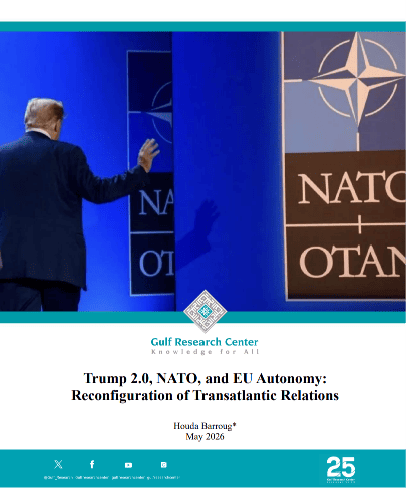
Trump’s second mandate has positioned US-EU relations in uncharted territory, turning a pillar of post-war order into a theater of volatility defined by realpolitik rather than partnership. The future of NATO as an alliance is increasingly in doubt, as strategic priorities divert and trust erodes, raising the possibility of selective disengagement, fragmentation, and/or functional decline.
Against this backdrop, the broader transatlantic order and European security are faced with profound uncertainties, primarily increased exposure to regional and global instability, intra-European burden-sharing pressures, and reduced deterrence credibility. Trump’s disruption has compelled the EU to be more strategically autonomous and resilient, prioritizing political cohesion and defense coordination. In addition, the EU is confronted with the task of meaningfully reshaping, or at least sustaining, the alliance on its own terms, considering the inconsistency of US leadership.
From Divergence to Strain
Unilateral US-Israeli military attacks on Iran have further exacerbated the EU-US relationship, particularly as it marks the first time EU member states have outspokenly defied and criticized the Trump administration. While the war on Gaza strained EU-US (and also EU-Israel) ties, the war on Iran has exposed fundamental divergences on regional and global security strategies. Moreover, neither conflict has produced strategic realignments. Instead, the EU has found itself fractured and subject to widespread public criticism, while experiencing a decline in relevance and credibility across the region. In addition, it is caught between supporting its longstanding allies, defending its own values, and coordinating a more Israelfriendly approach.
The unilateral attacks on Iran and the implications thereof clash sharply with the EU’s push for de-escalation, multilateral diplomacy, and humanitarian pauses. They also fuel regional chaos with enduring global ramifications, which the EU has so far not adequately addressed despite possessing tools to manage the crisis. As a result, the institutional and moral alignment that once underpinned the transatlantic partnership has gradually eroded, leading to fractures in approaches to intelligence sharing, regional security architecture, and hedging partnerships. These differences go beyond diplomatic friction and are currently translating into fragmentation within the transatlantic framework.
Multilateral institutions have become outlets for Trump’s frustration, and NATO is no exception. What was once a focal point of European security and transatlantic alignment has become a central arena where divergences and threats play out. In addition to the continuous threats to withdraw from NATO, Trump 2.0’s tendency to treat Article 5 as contingent on allies’ behavior has seismically shattered deterrence calculations in Brussels. It has become evident that it is no longer a matter of burdensharing, but a reality in which American and European governments diverge on threat hierarchies and management strategies. Against this backdrop, the alliance is more transactional and conditional in unprecedented ways, raising doubts about its future viability as the formal cornerstone of European defense.
Europe’s Response: The Dual-Track Strategy
Trump 2.0 has accelerated the decisive pivot toward European strategic autonomy, despite the latter’s initial rhetorical character. Debates on European strategic autonomy have occupied Brussels for the past decade, but the intensity of policy discussions, coupled with concrete initiatives, has increased in the past year. This can be seen in the Readiness 2030 initiative and surging defense spending and industrial ramp-ups prioritizing bloc-level supply chains to reduce reliance on transatlantic imports.
In practice, there needs to be a recalibration within NATO, particularly a strategic Europeanization of the alliance to ensure that EU priorities, concerns, and strategies are adequately reflected. This shift is not about disengaging from NATO but reshaping it. It would require but also allow the EU member countries to progressively assume more responsibilities and capabilities, closing existing gaps while leveraging EU expertise. The end point should not be replacing the US, but rather taking ownership of European defense, and ensuring that US involvement is an added benefit rather than its foundation.
Ongoing initiatives signal this shift, visible in higher defense budgets, more joint procurement, and France-UK-led assertive debate on EU roles in nuclear deterrence. Existing proposals vary from developing more formalized EU-level nuclear-sharing arrangements, extending the French nuclear umbrella with European partners, and positions that emphasize maintaining NATO’s existing nuclear framework while pushing to strengthen the bloc’s credibility and consultation prowess.
Current developments point to a bigger risk of strategic divergence turning into institutional decoupling. Even as Trump 2.0 continues to rail against EU defense industrial policies and procurement preferences, the EU should continue to double down rhetorically on EU-NATO cooperation, stressing the importance of joint planning and interoperability. A dual track, as uneasy as it will be for the EU, will allow the bloc to rely on NATO as the cornerstone of its collective defense while providing a stronger EU defense pillar capable of autonomous action when necessary. This would change the internal dynamics of the alliance, where the US, despite its indispensability, would not remain unquestioned. The endgame is to think of NATO less as a US-led and dominated protective umbrella and more as a framework that the EU must actively shape if it is to survive Trump 2.0.
The Future of NATO: Europeanization or Irrelevance
Building on these dual-track dynamics, NATO’s prospects hinge on managing this logic: advancing European autonomy without alienating Washington - or in the case of the current administration, provoking Trump. His attacks on the EU, along with accompanying threats, are likely to continue. European leaders should therefore continue to pursue de-risking through the development of complementary capabilities, while reinforcing the Eastern Flank alongside Poland and supporting the UK’s bridge-building role. Such an approach would help ensure that the alliance adapts rather than fractures.
* Houda Barroug is a Researcher at the Gulf Research Center (GRC)