Publications List

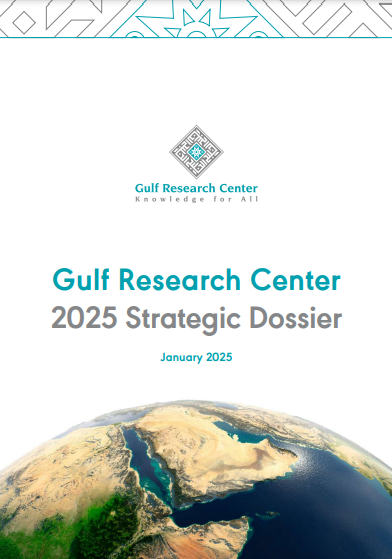
Gulf Research Center 2026 Strategic Dossier
- Gulf Research Center
As the Gulf region moves into 2026, it does so against a backdrop of persistent geopolitical tension, strategic uncertainty, and accelerating global change. Long-standing conflicts in Gaza, Yemen, Syria, Libya, and Sudan remain unresolved, while the evolving confrontation between Israel and Iran and the growing sophistication of nonstate actors continue to test regional stability and existing frameworks of deterrence and crisis management. At the same time, intensified great-power competition, shifting alliance structures, and ongoing ambiguity surrounding U.S. policy toward the Middle East, particularly on the Palestinian issue, Iran’s nuclear program, and Gulf security commitments, have reinforced perceptions of a more fluid and less predictable external environment.
This strategic dossier provides an analytical assessment of Gulf regional security and strategic positioning in 2026, situating current developments within broader structural transformations at both the regional and international levels. It examines the challenges facing the GCC in managing cohesion and divergence, the implications of multipolarity for Gulf engagement with multilateral institutions, and the evolving dynamics of key regional flashpoints, including Egypt’s role in regional security, Sudan’s ongoing state crisis, Iraq’s postelection pathways, Libya’s uncertain trajectory, and the enduring Syria question. The dossier also considers the impact of global power shifts on Gulf relations with the United States, the European Union, China, East Asia, and Africa, highlighting how external partnerships are being recalibrated amid fragmentation in global governance. In parallel, the dossier analyzes the Gulf’s evolving economic and strategic landscape in a period of global disorder. It explores the changing role of oil, natural gas, and sovereign capital as instruments of economic and political influence, alongside emerging strategic sectors such as energy transition technologies and critical minerals. Environmental security and sustainability feature as integral components of Gulf policy, reflecting efforts to balance long-term development objectives with climate-related risks. Finally, the dossier addresses key instruments shaping Gulf influence and resilience, including social cohesion, digital and technological autonomy in areas such as artificial intelligence and semiconductors, and the growing use of sports diplomacy as a tool of soft power. Overall, this strategic dossier is intended to serve as a timely and policy-relevant resource for understanding the Gulf region’s evolving strategic environment in 2026. By examining the intersection of security dynamics, economic transformation, sustainability and social challenges, it offers insights into the strategic imperatives shaping Gulf decision-making and the region’s role in regional and global affairs in the years ahead.
Other Publications