Publications List
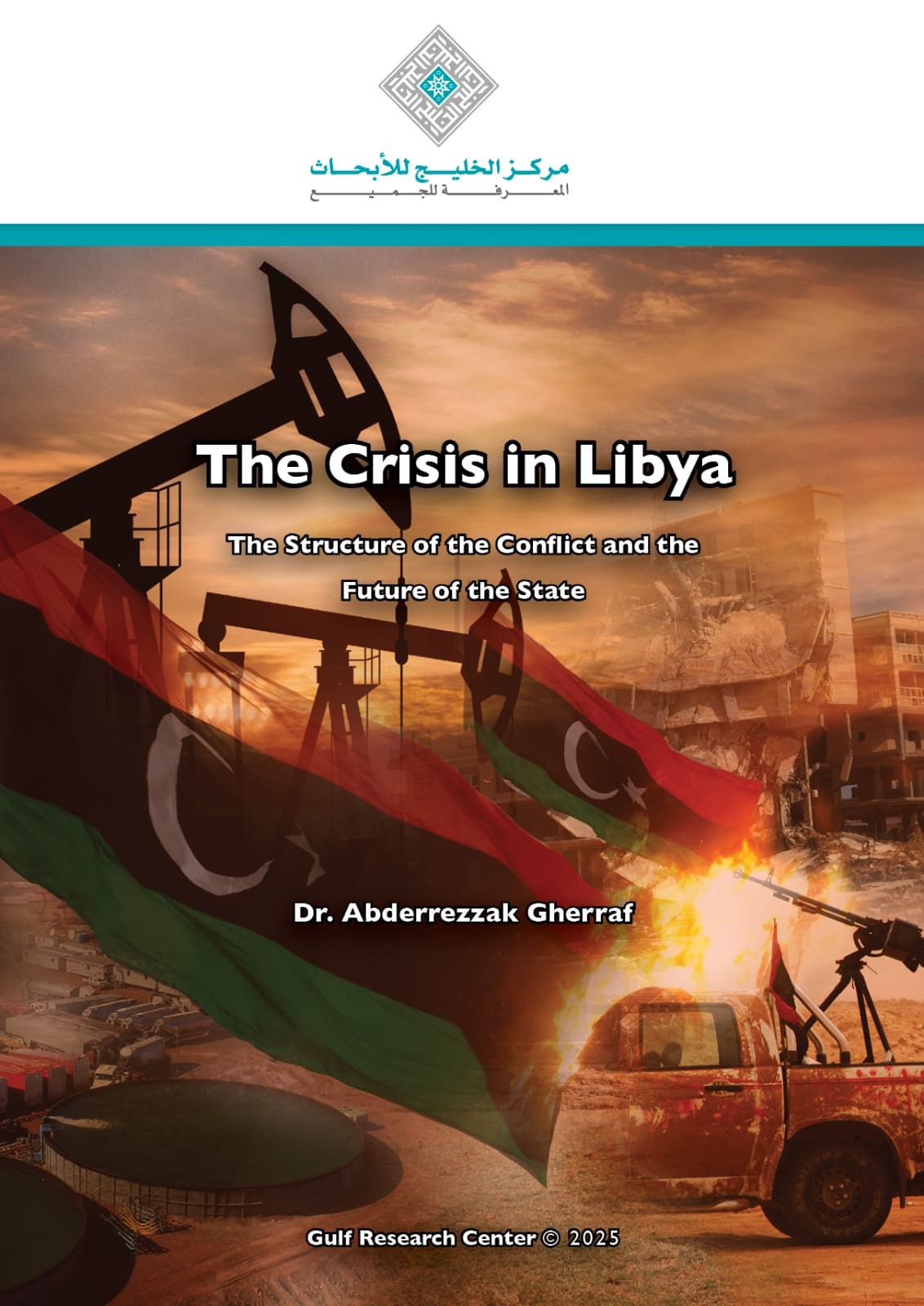
The Crisis in Libya: The Structure of the Conflict and the Future of the State
- Dr. Abderrezzaq Gherraf
In his book, “The Crisis in Libya: The Structure of the Conflict and the Future of the State,” Dr. Abderrezzak Gherraf, Senior Researcher at the Gulf Research Center, provides a comprehensive description, analysis, and prognosis of one of the most critical regional crises threatening the already fragile Arab regional order. Dr. Gherraf specializes in regional and international security, security threats, and risk management in fragile states. He also lectures on International Relations, Security, and Strategic Studies at universities in Algeria.
This book presents a critical and analytical examination of the Libyan crisis, making a valuable contribution to Arab academic literature. The crisis not only affects the stability of the Arab region but also has significant implications for the geopolitical landscape. Its effects extend across the Mediterranean to Europe and further south into Sub-Saharan Africa, exacerbating political instability in a vast area already facing a severe security vacuum and developmental challenges in many of its countries.Libya is situated at the center of a complex and turbulent region, where its crises have been worsened by both international and regional interventions. These interventions have transformed the country into a battleground for various international and regional powers vying for influence. Almost fourteen years after the fall of Muammar Gaddafi’s regime, Libya remains entrenched in a multifaceted crisis that encompasses political, security, economic, and social dimensions. Despite ongoing efforts to resolve the situation, the crisis continues to deepen, largely due to internal challenges posed by local actors, as well as external influences from various regional and international sponsors involved to varying degrees.Libya represents both a significant strategic asset, given its vast resources, and a potential strategic catastrophe should its crisis escalate further. Such a worsening could trigger a violent explosion with repercussions for its neighboring countries and the regional power dynamics, as well as altering international relations and Libya’s role within them.Libya is a nation with an ancient name that is deeply rooted in history, although its current geopolitical context is relatively nascent. Geographically, it is strategically situated at the heart of the southern Mediterranean coast, connecting the Arab Maghreb and Mashreq. Libya acts as a geostrategic gateway, linking the Mediterranean to Sub-Saharan Africa.In addition to its vast energy and groundwater reserves, Libya's extensive desert holds significant sources of clean and renewable energy. These resources are just a small part of Libya's geopolitical and geo-economic strategic assets, which have fueled, and will continue to fuel, the ambitions of major and rising powers seeking a foothold among global giants.These strategic advantages have consistently made the country a focal point for international competition and conflict throughout history. This struggle, dating back to the times of Roman and Carthaginian empires, the ancient Greeks and Pharaohs, through the Ottoman sultans, European colonial leaders, and the Russian tsars and their Soviet successors, persists today with the leaders of the White House and modern Russia. Libya's current crisis is not an anomaly; rather, it is one of the latest manifestations of this ongoing dynamic, adding another link in the long chain of its contentious history.The author's goal in this book is to fill a significant gap in academic literature by providing a comprehensive account of the intricate details and ongoing developments of the Libyan crisis. The research community has faced challenges in producing sufficient work to fully understand the multifaceted and complex nature of this crisis, which involves various levels of analysis that a single study cannot entirely cover. This complexity, along with its repercussions, extends beyond domestic borders, having an impact in both regional and international contexts. Compounding these challenges is the rapid pace of events and shifts in the balance of power, largely driven by the constantly changing loyalties among local actors. These actors navigate their internal relationships and affiliations with external sponsors, often despite conflicting interests and the complexities of their agreements and disagreements.The author aims to provide a thorough overview of the complexities surrounding the crisis, examining its historical roots, ongoing drivers, and various phases. The book also investigates the internal consequences of the crisis as well as its broader regional and international implications. It analyzes potential development scenarios and their effects on the future of the Libyan state, focusing on both governance and society.This analysis presents a framework for understanding the conflict's structure and explores state-rebuilding efforts in the context of available crisis response and peace-building initiatives. Additionally, it includes a prospective outlook on future developments based on established realities on the ground. All of these topics are explored across eight main themes that make up the book's content.The various levels of analysis regarding the book's subject matter have given rise to numerous complex questions that help illuminate the nature of the Libyan predicament and its intricacies. A central issue that needs to be addressed is the extent to which societal contradictions and the long-standing institutional vacuum have contributed to the emergence and entrenchment of this crisis.In this context, what is the anticipated impact of the ongoing structural disintegration of institutions in Libya on the future of a crisis settlement? What are the limitations of relying on regional and international agreements to provide what is needed for a resolution, especially given the rapidly shifting dynamics of agreement and disagreement among these parties, as well as their conflicting interests? What possible scenarios can we expect, considering the variables introduced by the failure of the 2020 Geneva agreement and the renewed divisions that continue to hinder the achievement of its intended goals?The Libyan landscape is characterized by a complex web of actors with differing interests and conflicting agendas, which has posed significant obstacles to reaching a resolution in the ongoing crisis. This intricate situation has made it difficult to establish a unified consensus among all stakeholders, resulting in a state of "Chronic Crisis." This is exemplified by the repeated failure of successive transitional periods to reach a sustainable agreement. Progress that has been made has often been short-lived, lasting only as long as the motivations behind it. Consequently, whenever efforts have succeeded in bridging differences, the conflict inevitably resurfaces, fueled by renewed tensions that continue to perpetuate the crisis.The Libyan issue is characterized by a high level of complexity as well as regional and international entanglements that exceed those of other crises in the region, including those in Syria, Egypt, Tunisia, and Yemen, which were influenced by the political transformations of 2011. While the situation in Syria is the closest parallel to Libya, given its impact on regional and international dynamics (things that complicate the resolution of both conflicts), local factors play a significant role as well.At the heart of the Libyan crisis is a unique convergence of the struggle for “power and wealth,” two determinants that intersect solely in the case of Libya. This exceptional nature not only distinguishes the Libyan crisis from others but also shapes its specific path towards resolution and settlement.Although the characteristics of this crisis are clear, the conditions necessary for a settlement have often been either absent or actively undermined. Even when some progress has been made, due to a minimal consensus locally, regionally, and internationally, any advancements have frequently reverted the conflict back to square one. As a result, Libya has been in a state of crisis for nearly a decade and a half.In light of the preceding analysis, this book makes a significant contribution to the academic discussion surrounding the Libyan crisis. The author carefully examines the complexities and ambiguities of the conflict, maintaining strict objectivity throughout. This approach is essential for producing credible research, which is necessary to identify effective and practical solutions to alleviate the devastating consequences of this ongoing conflict. The ultimate goal is to preserve Libya's unity and existence, ensuring that the state and its people do not endure further suffering beyond what the past years of crisis have already inflicted.As a result, the content may be embraced by some and challenged by others. This diverse reception occurs despite the author's genuine commitment to maintaining high standards of impartiality, along with a vigilant focus on factual accuracy. While the work conveys accurate information, it also clearly articulates the author's reasoned conclusions, inviting readers to engage with and reflect on the insights presented.
Other Publications