
Publications List
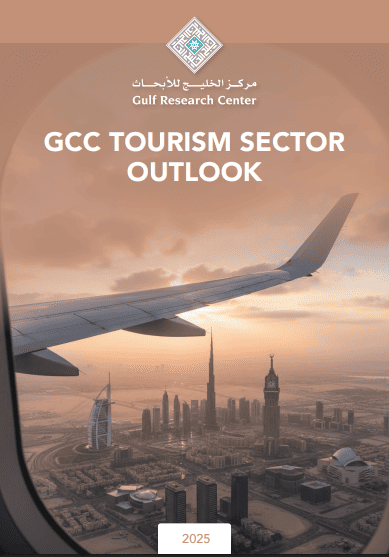
GCC Tourism Sector Outlook
- Gulf Research Center
Countries across the GCC have leveraged iconic landmarks, luxury hospitality, and world-class events to attract international visitors, collectively positioning the region as a premier global tourism hub. This broader engagement among all GCC members has driven increasing tourist arrivals and rising occupancy rates, signalling a strong recovery trajectory post-pandemic.
Countries across the GCC have leveraged iconic landmarks, luxury hospitality, and world-class events to attract international visitors, collectively positioning the region as a premier global tourism hub. This broader engagement among all GCC members has driven increasing tourist arrivals and rising occupancy rates, signalling a strong recovery trajectory post-pandemic. As per the Statistical Center for the Cooperation Council for the Arab States of the Gulf (GCC‑STAT), in 2024, the six GCC countries collectively attracted approximately 72.2 million international visitors, confirming the region’s status as a structurally important global tourism hub. Within this, market scale, positioning and value capture differ markedly by country, creating distinct strategic profiles across the bloc. Saudi Arabia, with 29.7 million visitors and around 41% share of GCC arrivals contributing 10.2% towards GDP including 4.4% direct contribution, is firmly established as the region’s largest tourism market, anchored in religious travel and increasingly diversified through business and leisure segments. Its mid-range receipts per arrival signal a broad visitor mix and substantial headroom to lift yield via upscale product development, experiential offerings, and longer average stays. In 2023, the UAE draws about 28.1 million visitors, accounting for roughly 39% of GCC arrivals contributing 12.40% towards GDP, underpinned by hub-class air connectivity, integrated infrastructure and strong destination branding. Very high receipts per arrival and a robust tourism development score demonstrate the effectiveness of its premium positioning in leisure, MICE and retail, with strategy focused on depth of spend and repeat visitation rather than sheer volume....
Other Publications