
Publications List
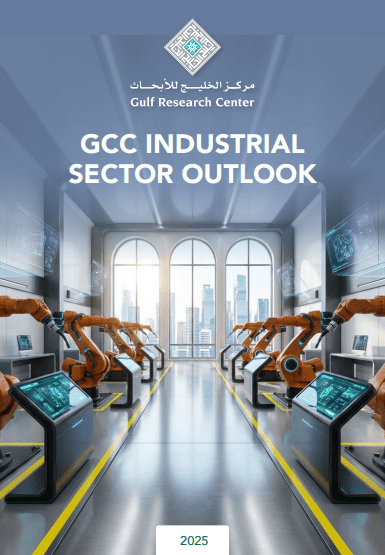
GCC Industrial Sector Outlook
- Gulf Research Center
The Gulf Cooperation Council (GCC) industrial sector is undergoing a pivotal transformation driven by economic diversification initiatives, rapid infrastructure development, and a growing focus on sustainability and digitalization. As the region transitions away from hydrocarbon dependency, industrial activity has emerged as a cornerstone of long-term economic resilience and competitiveness.
Key Growth Drivers include rising demand for industrial diversification, large-scale infrastructure projects, increased regional trade integration, and significant investments in advanced manufacturing technologies such as automation, AI, and 3D printing. The shift toward green and sustainable manufacturing—including clean hydrogen, renewable energy integration, and circular economy initiatives—is reshaping industrial policy and investment priorities. KSA dominates the GCC industrial landscape, particularly in petrochemicals and heavy industries, leveraging their vast natural resources and large-scale infrastructure to support high-volume production and global export capacity. Saudi Arabia’s geographic position provides a unique strategic advantage within the GCC. Saudi Arabia is the only GCC country with major ports on both the Red Sea and the Arabian Gulf. This dual-coast access allows the Kingdom to diversify trade routes, bypass single-point disruptions, and reduce exposure to regional maritime risks. The UAE, in contrast, has positioned itself as a hub for advanced manufacturing and logistics, capitalizing on their world-class ports, free zones, and innovation-driven industrial zones to support high-tech, precisionoriented industries. Qatar focuses on energy-intensive materials and downstream industries, using their abundant natural gas resources to fuel industries such as aluminum, fertilizers, and chemicals, integrating upstream energy assets with downstream industrial growth. Meanwhile, other GCC states such as Bahrain and Oman are taking a targeted approach, focusing on niche manufacturing segments. By leveraging strategic geographic locations and competitive energy costs, they attract specialized industries, including high-value assembly, light manufacturing, and certain downstream petrochemical processes, enabling sustainable industrial growth without overextending resources. Kuwait, on the other hand, is actively working to expand their refining and petrochemical sectors, aiming to diversify their industrial base beyond crude oil exports and increase value addition within their energy sector, strengthening their position within the regional industrial ecosystem.