Publications List
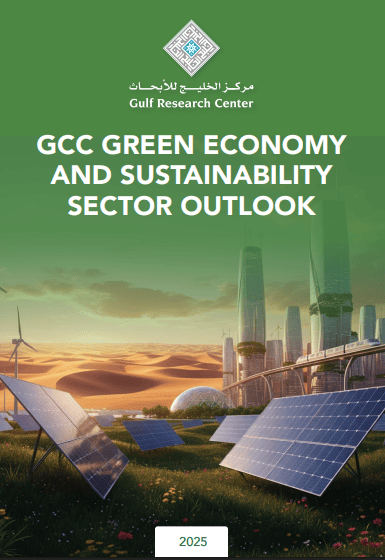
GCC Green Economy and Sustainability Sector Outlook
- Gulf Research Center
The GCC is rapidly shifting from a hydrocarbon-dependent model toward diversified, low-carbon, and sustainable growth, with sustainability now central to national development strategies. Governments across the region are promoting green growth through investments in renewable energy, sustainable construction, water and waste management, circular economy solutions, and green finance, supported by strong policy incentives and technological innovation.
The GCC is rapidly shifting from a hydrocarbon-dependent model toward diversified, low-carbon, and sustainable growth, with sustainability now central to national development strategies. Governments across the region are promoting green growth through investments in renewable energy, sustainable construction, water and waste management, circular economy solutions, and green finance, supported by strong policy incentives and technological innovation. In 2024, Saudi Arabia leads GCC renewable energy development, accounting for 53.3% of total capacity and over 60% of production, reflecting the scale of its clean-energy investments. The UAE follows with around 18% of capacity and 15% of production, driven by early adoption of large-scale solar projects. Kuwait, Qatar, Oman, and Bahrain currently contribute smaller shares, each below 10%, while all GCC countries have committed to net-zero or carbon-reduction targets by 2050–2060
Other Publications